
Topic Clusters Explained: The 7-Step SEO Framework B2B Brands Need
Learn how topic clusters work, why they outperform one-off blog posts, and how to build a cluster strategy that drives rankings, leads, and pipeline in B2B SEO.
B2B SEO fails when content is built like a news feed: disconnected posts, scattered keywords, and no clear path from search traffic to pipeline. Topic clusters fix that by organising content around buyer problems, strengthening internal linking, and making it easier for Google (and prospects) to understand what you’re best at.
This guide breaks down the topic cluster framework, shows you how to build one step-by-step, and includes a downloadable checklist you can hand to your team.
What a topic cluster is (and why Google rewards it)
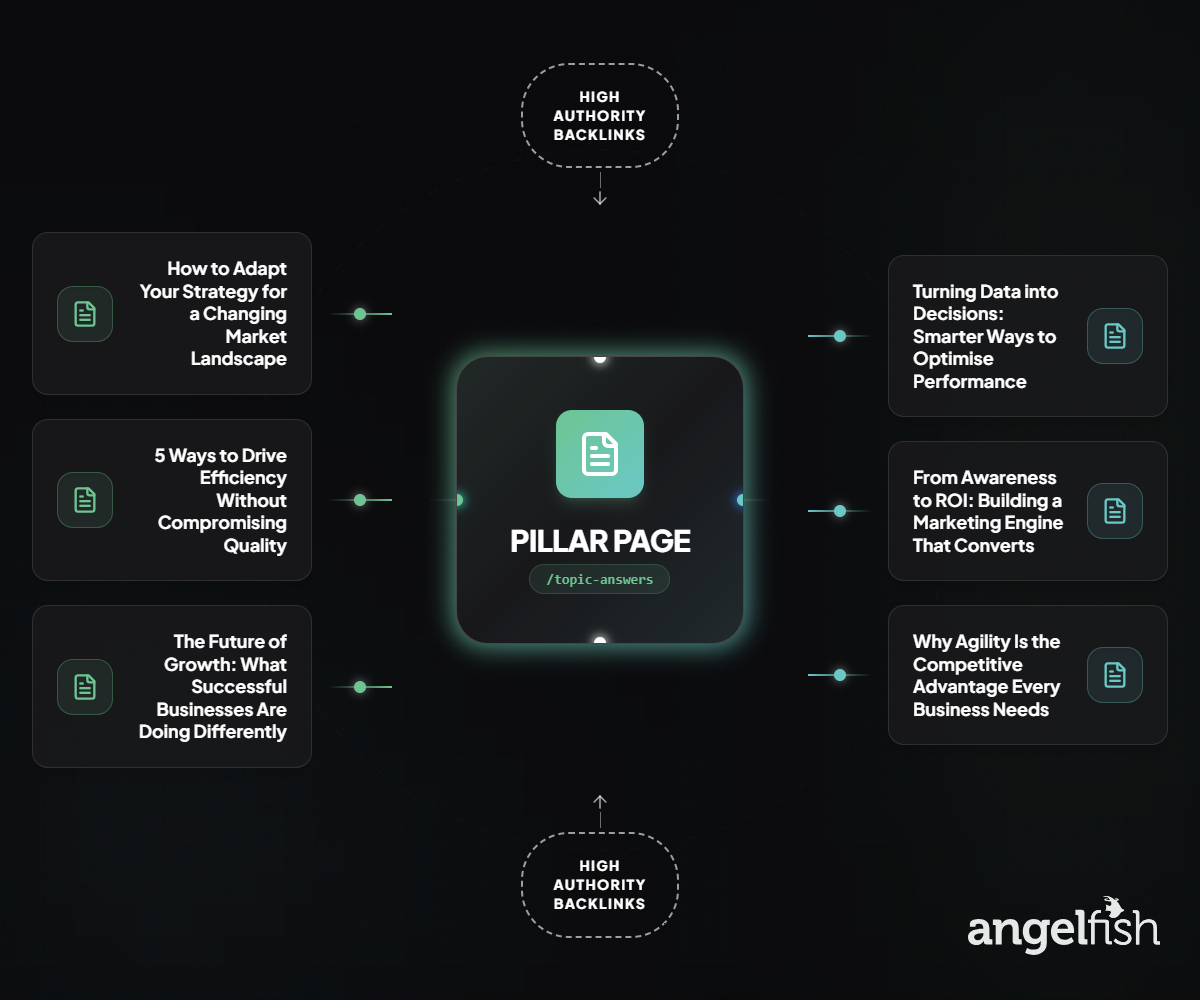
A topic cluster is a group of interlinked pages built around a core theme:
- A pillar page targets the broad, high-intent topic (e.g., “B2B marketing automation”).
- Cluster pages target specific subtopics and long-tail keywords (e.g., “marketing automation workflows”, “HubSpot lead scoring model”, “marketing automation KPIs”).
- External links (high-authority backlinks) point to the pillar page, boosting domain authority and signalling trust to search engines.
- Internal links connect cluster pages to the pillar (and often laterally between cluster pages), signalling topical authority.
Why this works in modern search
Google’s systems increasingly evaluate topical relevance and content relationships, not just whether a page repeats a keyword. Clusters help you:
- Build topical authority faster (multiple pages reinforcing one theme)
- Improve crawl efficiency (clear internal linking paths)
- Increase rank stability (less reliant on one “hero” post)
- Create a conversion journey (awareness to consideration to decision)
Practical takeaway: if your SEO plan is “publish 4 blogs a month”, you don’t have a strategy. If your plan is “publish 1 pillar + 8 supporting pages for a revenue theme”, you do.
Topic clusters vs keyword lists: the shift B2B teams must make
Most B2B teams still plan SEO like this:
- Export keywords from a tool
- Pick the highest volume terms
- Write separate posts for each
That approach creates two common problems:
- Keyword cannibalisation: multiple pages compete for the same intent.
- Thin topical coverage: you rank for the easy long-tails but never win the category terms that drive pipeline.
A cluster approach flips the planning model:
- Start with revenue themes (what you sell + what buyers research)
- Map buyer intent across the journey
- Build a content ecosystem that earns trust and rankings over time
Practical takeaway: measure success by cluster performance (rankings, traffic, assisted conversions), not by individual blog traffic.
The business case: how clusters drive leads and pipeline
Topic clusters aren’t an “SEO nice-to-have”. They directly support pipeline in three ways.
1) They increase the number of keywords you rank for
A well-built cluster naturally targets:
- The head term (pillar)
- Multiple mid-tail terms (cluster pages)
- Dozens of long-tail variations (within each page)
More rankings across one theme means more qualified entry points into your site.
2) They improve conversion rates through better journeys
Clusters let you design the path:
- Informational post to pillar explainer
- Pillar to comparison page / integration page
- Decision page to demo / consultation CTA
That structure typically reduces bounce and increases pages per session - strong leading indicators for conversion.
3) They make SEO easier to defend to the board
Clusters give you a clean reporting story:
- “This quarter we built authority around [theme].”
- “Traffic grew X% to cluster pages.”
- “We influenced £Y in pipeline via assisted conversions.”
Practical takeaway: set up tracking so you can attribute leads and influenced revenue to clusters (more on this in the measurement section).
The 7-step topic cluster framework (B2B-focused)
Use this process to build clusters that rank and convert.
1) Choose a revenue-first pillar topic
Start with themes tied to:
- Your highest-margin product/service
- Your shortest sales cycle
- Your strongest differentiation
- Your best-fit industries
Good pillar topics pass this test: if you ranked top 3 for it, would it create sales conversations?
Examples (B2B SaaS/tech):
- “Customer data platform”
- “SOC 2 compliance automation”
- “Warehouse management system”
- “HubSpot onboarding”
Action:
- 1List your top 5 revenue drivers.
- 2Map each to 3-5 buyer research themes.
- 3Choose 1 pillar to build first (don’t try to do five at once).
2) Validate intent (not just search volume)
Volume is a weak predictor of pipeline. Intent is stronger.
For each pillar candidate, check:
- What ranks now (are they vendors, guides, or Wikipedia-style definitions?)
- SERP features (ads, comparisons, “People also ask”)
- Whether results skew informational vs commercial
A practical intent rating system:
- High commercial intent: “software”, “platform”, “tool”, “pricing”, “alternatives”, “comparison”, “best”.
- Mid intent: “how to”, “framework”, “strategy”, “template”.
- Low intent: pure definitions with no buying context.
Action: prioritise pillars where you can realistically compete and where intent aligns with your funnel.
3) Build the cluster map (subtopics + journey stages)
A strong cluster includes content for multiple intents:
- Awareness: definitions, problems, frameworks
- Consideration: methods, implementation, templates
- Decision: comparisons, alternatives, integrations, pricing guidance
A simple cluster map template
Create a table with:
- Cluster page title
- Primary keyword
- Search intent (A/C/D)
- Funnel CTA (newsletter, template, demo)
- Internal links (to pillar + related pages)
Aim for 8-12 cluster pages per pillar to start. That’s enough to build authority without overwhelming your team.
Action: pull subtopics from:
- “People also ask” questions
- Competitor tables of contents
- Sales call objections
- Support tickets and implementation FAQs
4) Write the pillar page as the “hub” (not a mega blog)
Your pillar page should act like a category page for the topic - broad, scannable, and link-rich.
Pillar page structure that works for B2B:
- Clear definition + who it’s for
- Key use cases (by role/industry)
- Core concepts (short sections, not deep dives)
- Links out to cluster pages for depth
- Decision support (what to look for, pitfalls, evaluation criteria)
- Conversion path (CTA matched to intent)
Action checklist:
- Keep it 2,000-4,000 words (typically).
- Add a table of contents with jump links.
- Include 8-12 internal links to cluster pages.
- Add at least 1 “decision” section (e.g., evaluation checklist).
5) Create cluster pages that win long-tail + mid-tail queries
Cluster pages should be more specific and more actionable than the pillar.
What to include in cluster pages:
- A clear answer in the first 100 words
- A step-by-step method or framework
- Examples (screenshots, templates, sample outputs)
- A CTA aligned to the page intent
Avoid cannibalisation
Each cluster page must target a distinct intent. If two pages answer the same question, merge them.
Action:
- Create a “keyword-to-URL” map.
- Assign one primary keyword per page.
- Use internal links to connect related subtopics rather than duplicating content.
6) Build internal links like a system (not an afterthought)
Internal links are the engine of clusters. Done properly, they:
- Pass authority from high-performing pages to new ones
- Help Google understand relationships
- Move users through the journey
A practical internal linking model:
- Every cluster page links to the pillar using consistent anchor text.
- The pillar links back to every cluster page.
- Cluster pages cross-link where it’s genuinely helpful (especially between adjacent intents).
Action:
- 1Add a “Related guides” block to every cluster page.
- 2Use descriptive anchors (avoid “click here”).
- 3Audit internal links monthly as you publish.
7) Measure cluster performance (rankings + leads + pipeline)
If you only report traffic, you’ll struggle to defend SEO investment.
Track clusters at three levels:
Visibility (SEO health)
- Number of keywords ranking in top 3 / top 10
- Share of voice for the theme
- Growth in impressions (Google Search Console)
- AI/LLM visibility: how often your content is cited or referenced in AI-generated answers (ChatGPT, Perplexity, Google AI Overviews)
- Featured snippet and AI Overview capture rate: percentage of cluster keywords where your content appears in zero-click results
- Brand mention tracking in LLM outputs: monitor whether AI tools recommend your brand when users ask about your topic area
Engagement (content quality)
- Scroll depth / time on page
- Pages per session within the cluster
- Internal link click-through rate
Revenue impact (what leadership cares about)
- HubSpot attribution reporting (track which cluster pages influence deals)
- HubSpot influenced revenue (use lifecycle stages and campaign tracking)
- Demo requests and MQLs attributed to cluster CTAs
Action:
- Create a GA4 exploration for “landing page = cluster URLs”.
- In HubSpot, ensure CTAs/forms capture original source and content offer.
- Report monthly on: traffic to leads to MQL to SQL to pipeline for the cluster.
Topic Cluster Build Checklist (copy/paste)
Use this as your internal worksheet.
Pillar selection
- [ ] Pillar ties directly to a revenue line
- [ ] SERP intent matches your funnel
- [ ] You can produce 8-12 supporting pages in 60-90 days
- [ ] You have (or can create) a conversion offer for the theme
Cluster mapping
- [ ] 8-12 cluster topics mapped to awareness/consideration/decision
- [ ] One primary keyword per URL (no duplicates)
- [ ] CTA defined per page (template, guide, demo, consultation)
- [ ] Internal link plan documented (pillar ↔ cluster + lateral links)
Content production
- [ ] Pillar page includes TOC, evaluation criteria, and links to every cluster page
- [ ] Cluster pages include steps, examples, and a clear “next step” CTA
- [ ] On-page SEO basics done (titles, H1/H2s, meta descriptions, schema where relevant)
Measurement
- [ ] HubSpot traffic analytics report created for cluster URLs
- [ ] HubSpot campaign tracking applied to CTAs/forms
- [ ] Monthly reporting includes rankings + leads + pipeline influence
Common mistakes (and how to avoid them)
Mistake 1: Building clusters around what you want to sell, not what buyers search
Fix: use sales calls, Gong/Chorus notes, and support logs to find the language buyers actually use.
Mistake 2: Treating the pillar as a “long blog post”
Fix: make it a navigational hub with short sections and strong internal links.
Mistake 3: Publishing the pillar without cluster pages
Fix: launch in a minimum viable cluster: pillar + 3-5 cluster pages, then expand.
Mistake 4: No conversion path
Fix: every page needs a next step. Awareness pages can offer a checklist; decision pages should push demos.
A practical 30-day rollout plan
If you need to move fast, use this schedule.
Week 1: Strategy
- 1Choose pillar topic + validate intent
- 2Build cluster map (8-12 pages)
- 3Define CTAs and HubSpot tracking plan
Week 2: Pillar build
- 1Draft pillar page
- 2Create TOC + internal link placeholders
- 3Publish pillar (even if some cluster pages are “coming soon”)
Week 3: Cluster content sprint
- 1Publish 3-4 cluster pages (mix awareness + consideration)
- 2Add internal links (pillar ↔ clusters)
- 3Add conversion CTAs
Week 4: Decision content + optimisation
- 1Publish 1-2 decision pages (comparison/alternatives/integrations)
- 2Optimise internal linking and meta data
- 3Set up reporting dashboard (GSC + HubSpot)
Next step: build your first revenue cluster
Topic clusters are one of the few SEO frameworks that reliably connect rankings to revenue - because they force you to organise content around buyer intent, not publishing cadence.
If you want a second pair of eyes on your cluster map (or you’d like us to build it with you in HubSpot), book a consultation: Talk to Angelfish Marketing. For a deeper dive on planning, see our related guide: B2B SEO strategy that drives pipeline.
Build one cluster around a revenue theme, measure it properly, then scale what works. That’s how B2B SEO becomes predictable.
Free Offer
Give Your Marketing the
Boost It Deserves
Our team of experts is ready to build a data-driven strategy tailored to your growth goals. Book a free strategy session to discover how we can help.
- Competitor analysis
- Content audit & recommendations
- SEO performance review
- Lead generation strategy
- Actionable 90-day plan